Some links on this page are affiliate links: if you book through them, we may earn a commission at no extra cost to you. How this works
Most visitors want one number for the Madeira climate, and the island refuses to give one. Madeira temperature by month in Funchal barely moves: the average daytime high runs from 19.9 °C in February to 26.8 °C in August, by the IPMA normals for the Funchal Observatory, and the nights from 13.9 °C to 20.7 °C. What changes through the year is the rain, the sunshine and the sea.
The bigger difference is height and side. Funchal sits on the sheltered south coast; the mountains above it and the north side beyond are colder and far wetter, and a day that is sunny at the harbour can be misty and raining at a levada an hour away.
Two outings that suit most months: the sea on a calm day, the peaks on a clear one.
 Most reviewed
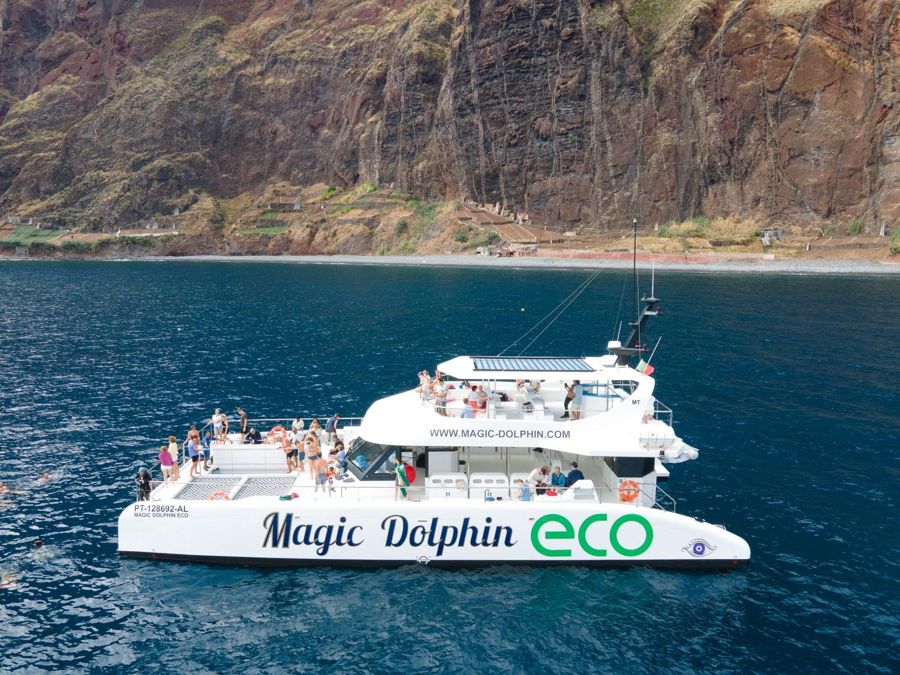
From Funchal: Ecological Catamaran Dolphin Whale Watching
Dolphins and whales off Funchal, in any season
 Sunrise
Funchal: Pico do Arieiro Sunrise Hiking Transfer
Sunrise above the clouds on a clear morning
The coast, the mountains and the north
The usual mistake is to plan the whole island by the forecast for Funchal. Madeira has several climates within an hour's drive.
At Queimadas, above Santana on the north side, the weather station averaged 2,314.6 mm of rain a year over 1941-1970, and its highs ran from 12.4 °C in January to 20.4 °C in September. November there brought 391.0 mm, nearly five times Funchal's 80.3 mm. Machico, on the dry eastern coast, averages about 710 mm a year.
The forest is the reason for the difference, and the result of it. The Laurisilva grows mainly on the north-facing slopes, between about 300 m and 1,300 m, where the clouds from the Atlantic meet the mountains; the madeira fog forest photographs show is that meeting. At Fanal, in the Laurisilva of the north-west, fog is frequent because of the altitude, in any season, and Paul da Serra, the plateau above it, sits at about 1,500 m.
So pack for two climates. A day on the coast in summer clothes can become a day in the mountains that needs a warm layer and a waterproof, whatever the month.
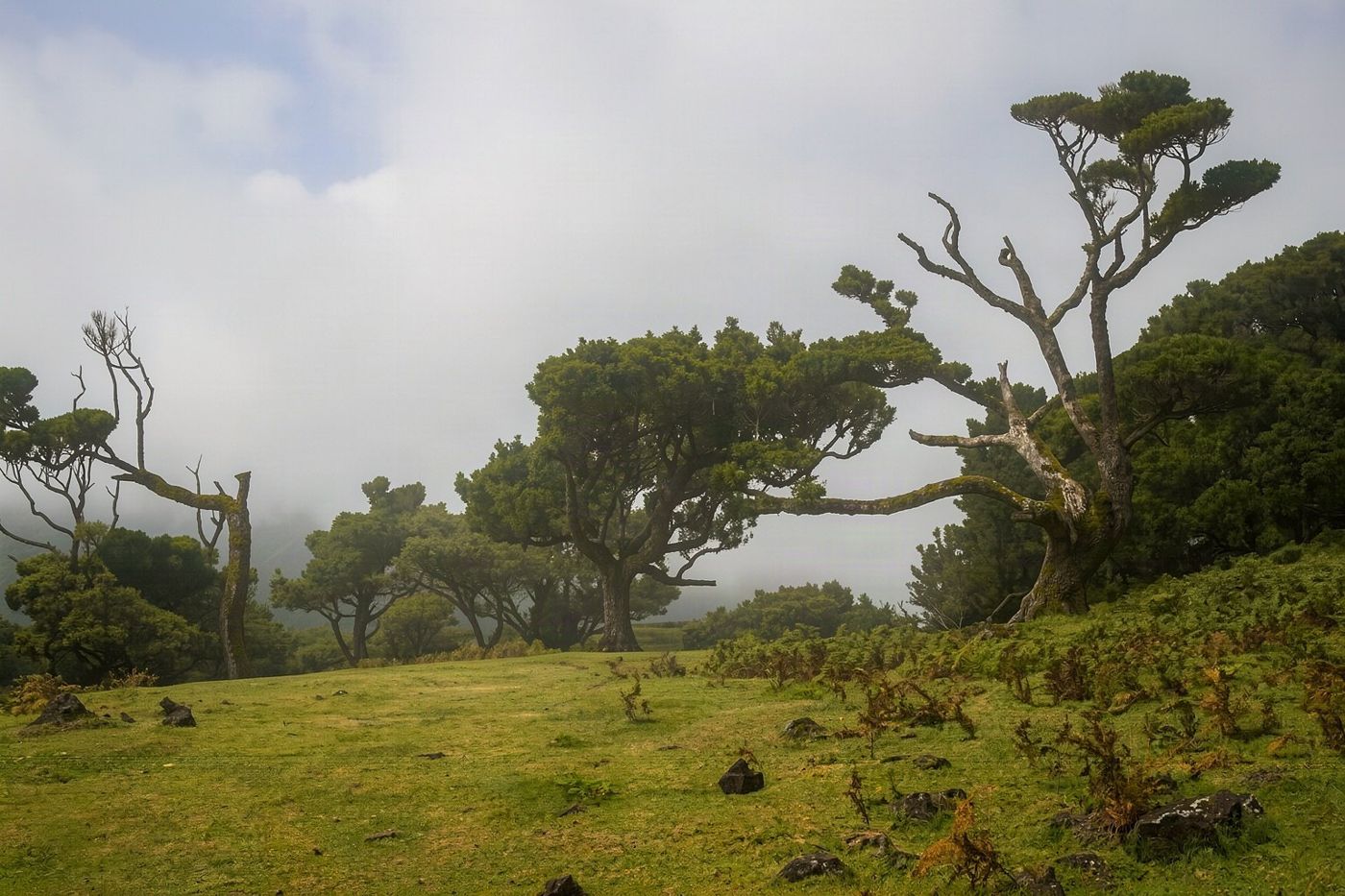 At Fanal, fog is frequent because of the altitude in any season within the Laurisilva.
Air temperature through the year
People often expect a hot summer and a cold winter. Funchal has neither.
The madeira average temperature by month, by day, stays between 19.9 °C and 26.8 °C: about 20 °C from December to April, 22.0 °C in May, 23.7 °C in June, 25.4 °C in July, 26.8 °C in August, 26.6 °C in September, 25.2 °C in October and 22.8 °C in November. Nights follow the same curve, from 13.9 °C in February to 20.7 °C in August.
That flat curve shapes the madeira best visit time weather question. There is no bad month for mild air; the choice is between the dry, sunny and warm-sea months from June to September, the green and flowering spring from March to May, and the mild, wetter winter from November to February, when Funchal is still around 20 °C by day.
The warmest month is August and the coolest is February, by a gap of only 6.9 degrees by day. For the full picture of each month, with the months either side, open its page from the list at the end.
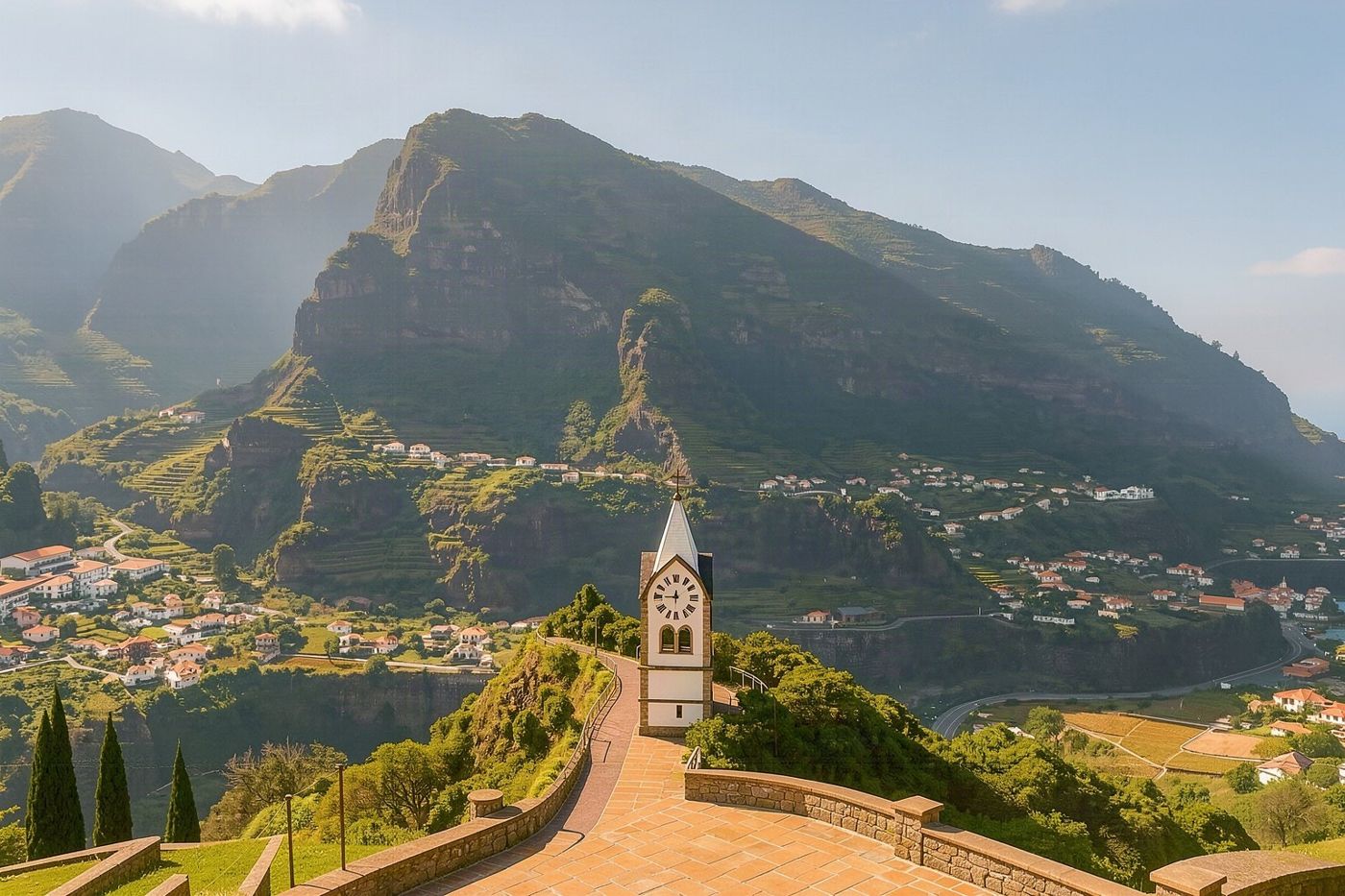 August is the warmest month by day with temperatures reaching 26.8 °C.
The sea, month by month
Visitors often expect the sea to follow the air. It lags behind it by about a month.
The madeira water temperature by month, measured at the Pontinha pier in Funchal harbour, has these normals: 18.3 °C in January, 17.7 °C in February, 17.6 °C in March, 17.8 °C in April, 18.6 °C in May, 20.1 °C in June, 21.6 °C in July, 22.6 °C in August, 22.9 °C in September, 22.3 °C in October, 20.9 °C in November and 19.5 °C in December. They are derived from the regional statistics office's monthly releases of IPMA data, which give each month's mean and its difference from the normal.
The coolest water is in March, not January, and the warmest in September, not August. October's sea is warmer than July's, and November's warmer than June's, which is why autumn is a good time to swim.
Recent months have run warm: the measured means in 2025 and 2026 were above the normals in every month that states a difference, by 0.3 to 1.1 degrees. Treat the normals as the floor rather than the forecast.
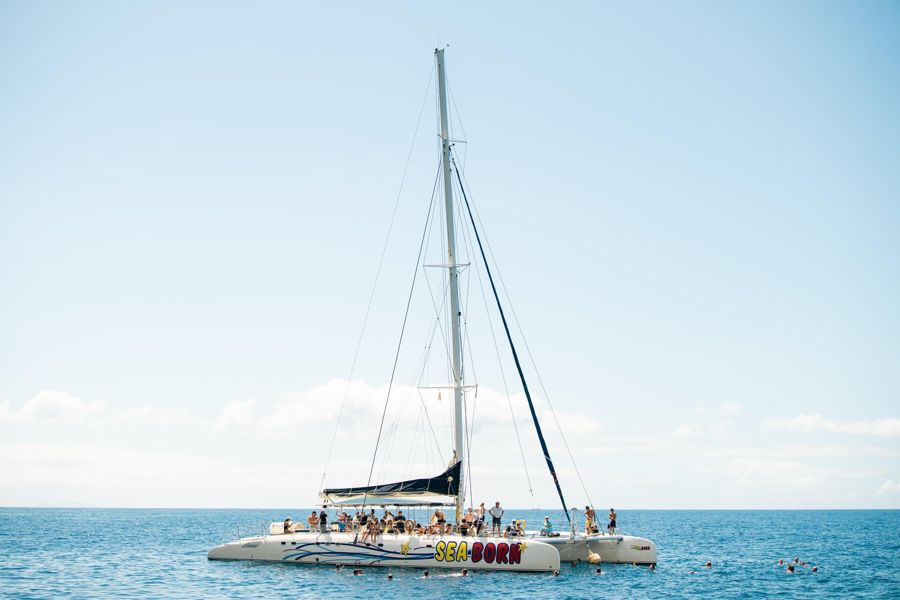
Funchal: Dolphin and Whale Watching Catamaran Cruise
★ 4.6 · 6,772 reviewsA catamaran cruise from Funchal, best in the calm, warm seas of summer and autumn.
Rain and sunshine
The mistake is to read an average of 90 mm as a month of rain. In Funchal the rain comes in spells, and the dry days between them are many.
The wettest months are December, 94.8 mm, October, 91.2 mm, and November, 80.3 mm. January and February bring 67.1 mm and 72.4 mm, March 62.3 mm and April 45.2 mm. Then the rain nearly stops: 27.2 mm in May, 7.8 mm in June, 1.7 mm in July and 1.3 mm in August, before September's 23.1 mm announces the autumn.
Sunshine follows the rain in reverse. It is lowest in December, about 151 hours, and highest in August, about 237, with July close behind at about 233. March brings the biggest jump of the year, from about 167 hours in February to about 198.
For walking, the dry months matter more than the warm ones, because the mountains and the north take far more rain than the coast. For the beach, the sunshine from May to September is the reliable part of the year.
- Warmest month
- August, 26.8 °C by day
- Coolest month
- February, 19.9 °C by day, 13.9 °C at night
- Wettest month
- December, 94.8 mm
- Driest month
- August, 1.3 mm
- Warmest sea
- September, 22.9 °C
- Coolest sea
- March, 17.6 °C
The seasons, and what is on
Visitors often plan around the weather and miss the calendar. In Funchal the calendar is as much of a reason to choose a month.
Winter, December to February, is mild and wetter, with the Christmas season from 1 December to 10 January in the 2026-27 programme, the New Year's Eve fireworks over the bay, and Carnival, 3 to 14 February in 2027. Days are around 20 °C, nights about 14 to 15 °C.
Spring, March to May, brings more sun and less rain, and the Flower Festival from 29 April to 30 May in 2027. It is the green season, and the best for walking before the heat.
Summer, June to August, is dry and warm, with the Atlantic Festival's Saturday fireworks in June, the Funchal Jazz Festival in July and the start of the Wine Festival at the end of August. The Lido's bathing season runs from June to September.
Autumn, September to November, keeps the warm sea as the rain returns, with the wine harvest in September and the Nature Festival, 6 to 11 October in 2026.
Funchal month by month: high / low, rain, sea
- January
- 20.0 / 14.3 °C, 67.1 mm, sea 18.3 °C
- February
- 19.9 / 13.9 °C, 72.4 mm, sea 17.7 °C
- March
- 20.6 / 14.3 °C, 62.3 mm, sea 17.6 °C
- April
- 21.0 / 14.9 °C, 45.2 mm, sea 17.8 °C
- May
- 22.0 / 16.2 °C, 27.2 mm, sea 18.6 °C
- June
- 23.7 / 18.2 °C, 7.8 mm, sea 20.1 °C
- July
- 25.4 / 19.7 °C, 1.7 mm, sea 21.6 °C
- August
- 26.8 / 20.7 °C, 1.3 mm, sea 22.6 °C
- September
- 26.6 / 20.4 °C, 23.1 mm, sea 22.9 °C
- October
- 25.2 / 19.2 °C, 91.2 mm, sea 22.3 °C
- November
- 22.8 / 17.0 °C, 80.3 mm, sea 20.9 °C
- December
- 21.0 / 15.5 °C, 94.8 mm, sea 19.5 °C
Swimming and the beaches
People arriving in winter often ask whether they can swim. Some do; most wait for June.
The madeira sea temperature reaches 20 °C in June and stays above it until November, which is the comfortable season for most swimmers. From December to May it is between 17.6 °C and 19.5 °C, fresh but not cold for a short swim on a sunny day.
The official bathing season is shorter than the swimming one. The Lido complex opens from June to September, at €6 for an individual entry, and five of Funchal's bathing areas carry a Blue Flag in 2026: Barreirinha, Ponta Gorda-Poças do Governador, Clube Naval do Funchal, Formosa and the Lido. Across the region, 60 bathing waters were identified for the 2026 season.
Outside the season, check what is open before planning a swim, and check the sea state as well as the temperature: a calm, sunny day in November can be better for a swim than a windy one in June.
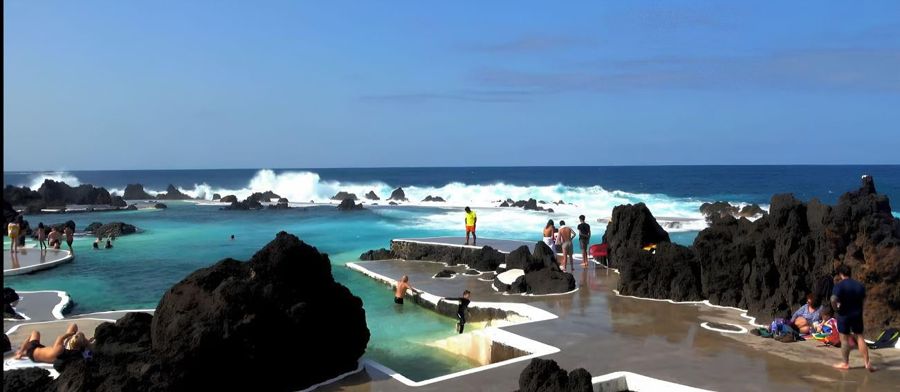
From Funchal: West Madeira Waterfalls and Fanal Forest Tour
★ 4.7 · 3,827 reviewsThe west coast waterfalls and the Fanal forest, best on a clear day.
Forecasts, wind and the month pages
The mistake is to plan a week in the mountains from a monthly average. Averages choose the month; the forecast chooses the day.
The IPMA, Portugal's weather institute, publishes the official forecasts and warnings for Madeira. A weather warning does not automatically close every walking trail; closures are decided case by case and posted by the IFCN on its trail pages.
Wind matters for arrivals. Strong wind at Madeira Airport regularly cancels and diverts flights: on 5 March 2026, seven were cancelled and five diverted. On a windy forecast, allow a spare day at the end of the trip rather than a tight connection.
The madeira climate average temperature year round is mild enough that most plans work in most months. For each month's air and sea temperature, rain, sunshine, mountains and events against the months either side, open its page: January, February, March, April, May, June, July, August, September, October, November, December. For the choice between them, see the best time to visit Madeira.
Common questions
What is the warmest month in Madeira?
August, with an average high of 26.8 °C and a low of 20.7 °C in Funchal. September is almost as warm and has the warmest sea.
What is the coldest month?
February, with an average high of 19.9 °C and a low of 13.9 °C in Funchal. The mountains are much colder.
When is the sea warmest?
In September, about 22.9 °C at Funchal. It is coolest in March, about 17.6 °C.
Which months are wettest?
December, October and November in Funchal, with 94.8, 91.2 and 80.3 mm. July and August are almost dry.