Some links on this page are affiliate links: if you book through them, we may earn a commission at no extra cost to you. How this works
Travellers planning Madeira often hear that it has no beaches, and it is half true. Most Madeira beaches are pebble or rock, with bathing complexes, sea pools and ladders into the Atlantic, and the sand beaches are few. But the island has 14 Blue Flag beaches in 2026, and the neighbouring island of Porto Santo three more, with 9 km of golden sand.
The sand, where it exists, comes in three kinds. Natural black sand, at Seixal on the north coast. Natural coppery sand of volcanic origin, at Prainha near the eastern tip. And imported sand, at Machico in the east and Calheta in the west, both in sheltered bays.
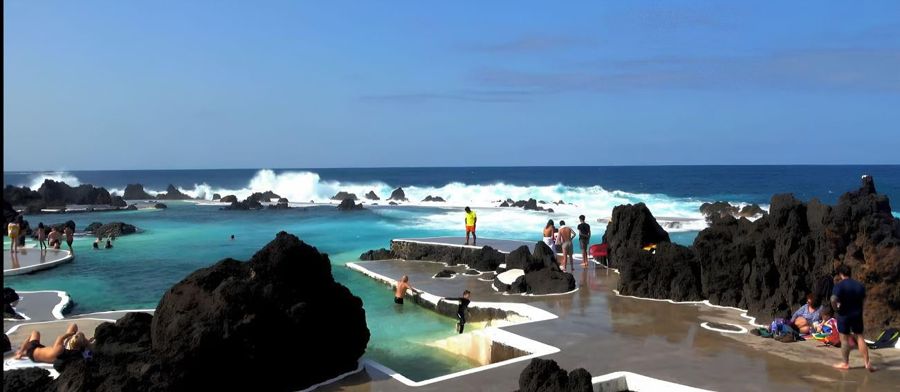
Around them are the lava pools of Porto Moniz, the complexes and free beaches of Funchal, and a sea that stays above 20 °C from June to November.
Two ways into the sea from Funchal beyond the beaches.
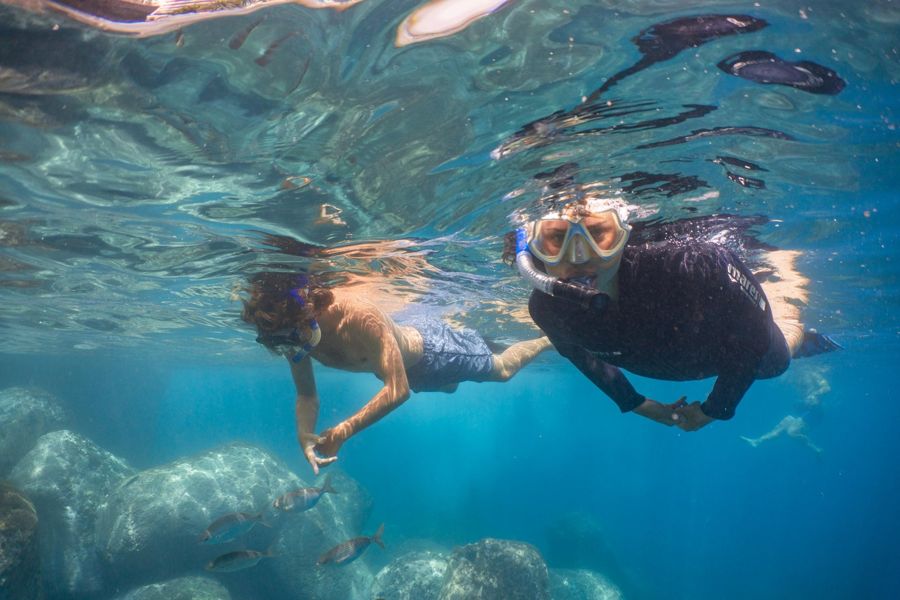 Snorkelling
Funchal: Snorkeling Adventure in Eco-Park / Shore or by Boat
Snorkelling from the shore or a boat
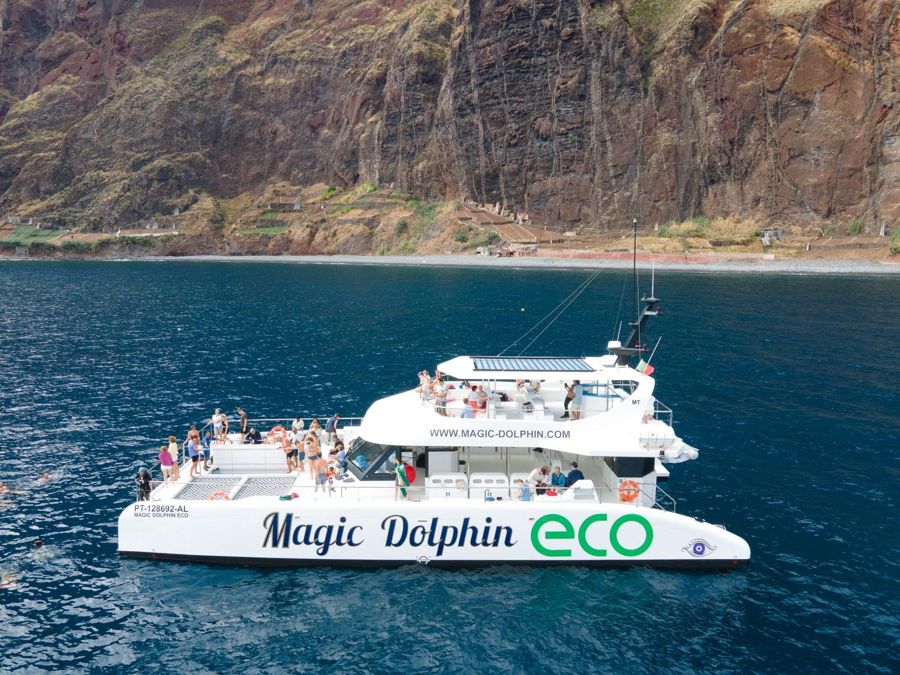 Most reviewed
From Funchal: Ecological Catamaran Dolphin Whale Watching
Dolphins and whales off the coast
Sand, pebble and pools
The common mistake is to expect every beach to be sand, or none. Madeira has each kind, in different places.
The best beaches in Madeira for sand are Seixal, with its black volcanic sand under the north-coast cliffs, and Prainha, with natural coppery sand near the Ponta de São Lourenço. Machico and Calheta have soft imported sand in sheltered bays, the easiest choice with small children. Porto Santo, about 2h15 away by ferry, has 9 km of golden sand made of shell, coral and algae fragments.
For swimming without sand, the island's answer is the sea pool and the bathing complex. The Porto Moniz lava pools cost €3 and have lifeguards; in Funchal, the complexes cost €6, and Praia Formosa, 2 km of sand and pebble, is free.
The Reis Magos beach Madeira visitors find in Caniço, in the municipality of Santa Cruz, carries a Blue Flag in 2026, as does Palmeiras in the same municipality.
Most of the rest of the coast is pebble and rock. Bring shoes for the water, whichever beach you choose.
Madeira's sand beaches from Funchal
| Beach | Sand | By road from Funchal | Blue Flag 2026 |
|---|---|---|---|
| Machico | Imported, sheltered bay | 21.8 km, 23 min | Yes, Banda d'Além |
| Prainha, Caniçal | Natural, coppery, volcanic | Near the Ponta de São Lourenço | Yes |
| Calheta | Imported yellow, about 100 m | 34.6 km, 39 min | Yes |
| Seixal | Natural black | 40.6 km, 47 min | No |
| Praia do Areeiro, Funchal | Black sand and pebbles | In Funchal | No |
| Porto Santo | Natural golden, 9 km | About 2h15 by ferry | Yes, three beaches |
- Sand
- Imported, sheltered bay
- By road from Funchal
- 21.8 km, 23 min
- Blue Flag 2026
- Yes, Banda d'Além
- Sand
- Natural, coppery, volcanic
- By road from Funchal
- Near the Ponta de São Lourenço
- Blue Flag 2026
- Yes
- Sand
- Imported yellow, about 100 m
- By road from Funchal
- 34.6 km, 39 min
- Blue Flag 2026
- Yes
- Sand
- Natural black
- By road from Funchal
- 40.6 km, 47 min
- Blue Flag 2026
- No
- Sand
- Black sand and pebbles
- By road from Funchal
- In Funchal
- Blue Flag 2026
- No
- Sand
- Natural golden, 9 km
- By road from Funchal
- About 2h15 by ferry
- Blue Flag 2026
- Yes, three beaches
The Blue Flags
Visitors often read "Blue Flag" as "sand". It is an award for the bathing area, whatever the shore is made of.
The 2026 Blue Flag list names each Madeira beach Portugal has given the award: 17 in the region. On the main island they are Porto Moniz; Calheta; five in Funchal, the Clube Naval do Funchal, Ponta Gorda-Poças do Governador, Formosa, the Lido complex and Barreirinha; Palmeiras and Reis Magos in Santa Cruz; Ribeira do Natal, Banda d'Além and Prainha in Machico; Ribeira do Faial in Santana; and Ribeira Brava. On Porto Santo, Fontinha, Cabeço da Ponta and Ribeiro Salgado carry it.
That mix is the island in short: lava pools, city complexes, pebble beaches and a few of sand, all judged by the same standard. The 2026 Blue Flag list has the full regional table, and Porto Moniz is also the region's Blue Centre for environmental education.
- Blue Flags 2026
- 17 in the region, 3 of them on Porto Santo
- Natural sand
- Seixal (black), Prainha (coppery), Porto Santo
- Imported sand
- Machico, Calheta
- Lava pools
- Porto Moniz, €3
- Warmest sea
- About 22.9 °C in September
Black sand
The mistake is to expect black sand to feel like a desert beach. It is volcanic, dark and often mixed with pebbles.
The Madeira black sand beach most visitors know is Seixal, on the north coast, 40.6 km from Funchal, about 47 minutes by road: one of the island's few natural sand beaches, black and volcanic, at the foot of green cliffs. It faces the open Atlantic, so pick a calm day.
In Funchal itself, the Praia do Areeiro has black sand and pebbles below the cliffs of the south coast. On the east coast, the Praia da Alagoa at Porto da Cruz has black sand below a green mountain.
Prainha, near the eastern tip, is darker than yellow but not black: its natural sand is coppery, of volcanic origin, in a dry, brown landscape.
Black sand heats up quickly in the sun, so bring shoes. The Seixal guide covers that beach and the pools nearby.
From Funchal: West Madeira Waterfalls and Fanal Forest Tour
★ 4.7 · 3,827 reviewsThe west and north-west in a day from Funchal, past Seixal's black sand.
Beaches, of a kind
People often cross Madeira off a beach list on hearsay. The honest answer is yes, of a particular kind.
Does Madeira have beaches? It has 14 Blue Flag bathing areas on the main island in 2026, from lava pools to city complexes, and a handful of sand beaches: Seixal and Prainha with natural sand, Machico and Calheta with imported sand, and the Praia do Areeiro in Funchal with black sand and pebbles.
What it does not have is a long stretch of natural sand on the main island. For that, there is Porto Santo, the neighbouring island, where the beach runs 9 km along the south coast, about 2h15 by ferry from Funchal.
Most of the main island's shore is pebble or rock. That shapes how people swim: from ladders into the sea, from complexes with pools, and from natural pools in the lava at Porto Moniz and Seixal.
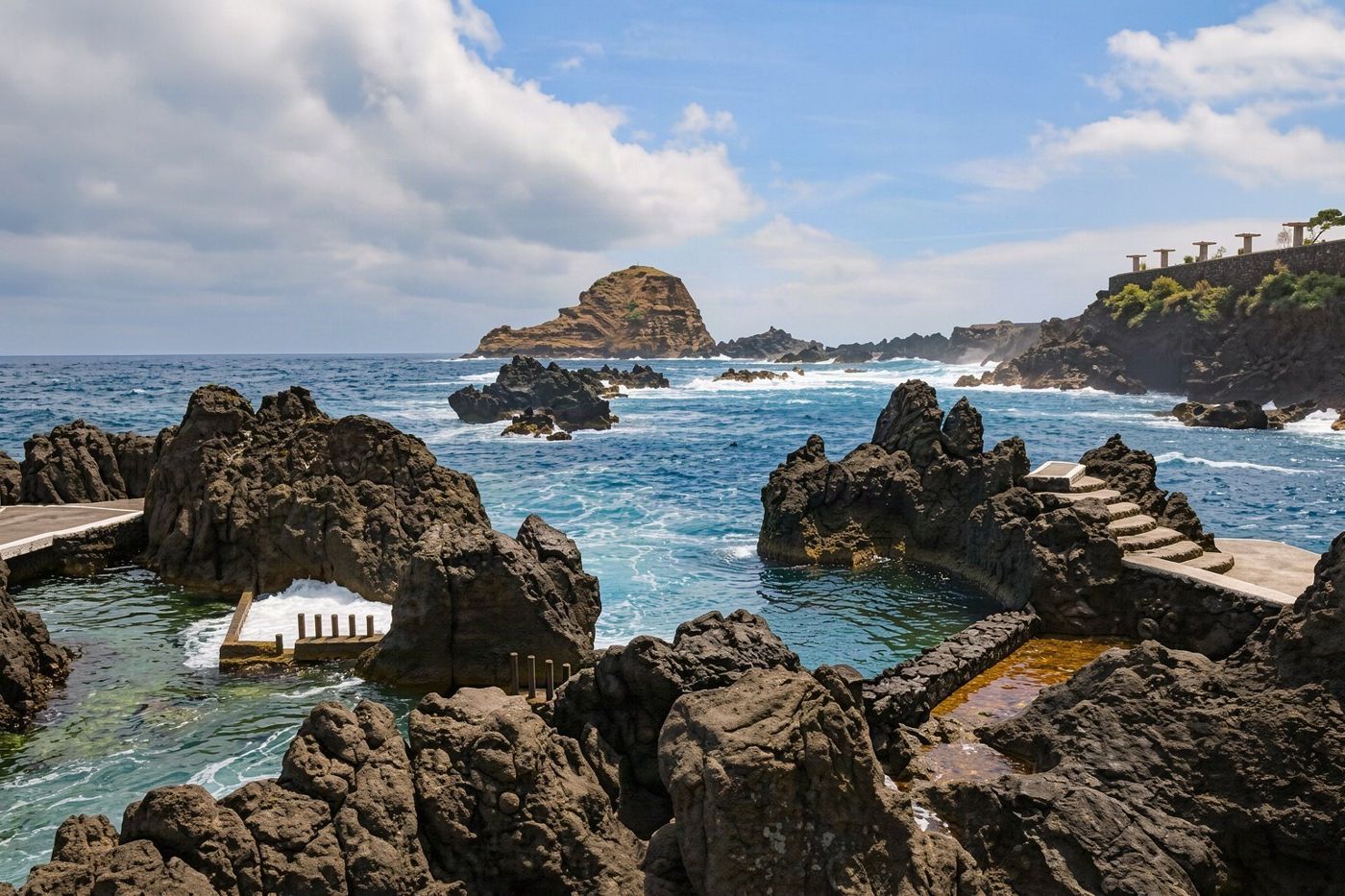 Most of the main island's shore is pebble or rock, with natural pools available at Porto Moniz.
A beach holiday?
Visitors often choose Madeira for its sea and then find the swimming is different from the Mediterranean. Know what to expect.
Is Madeira good for beaches? For sea swimming, yes, from June to November, when the sea off Funchal stays above 20 °C and peaks at about 22.9 °C in September; the bathing season, with lifeguards, runs from June to September. For lying on sand all week, it is better on Porto Santo, with its 9 km of beach.
On the main island, most days at the sea mean a complex, a pool or a pebble shore, and a morning's swim often combines with a walk, a viewpoint or a town. The sand beaches of Machico and Calheta are the exception, and the easiest for families.
A good compromise for a beach-minded stay is a base in Funchal with two or three nights on Porto Santo. The Porto Santo guide covers the crossing.
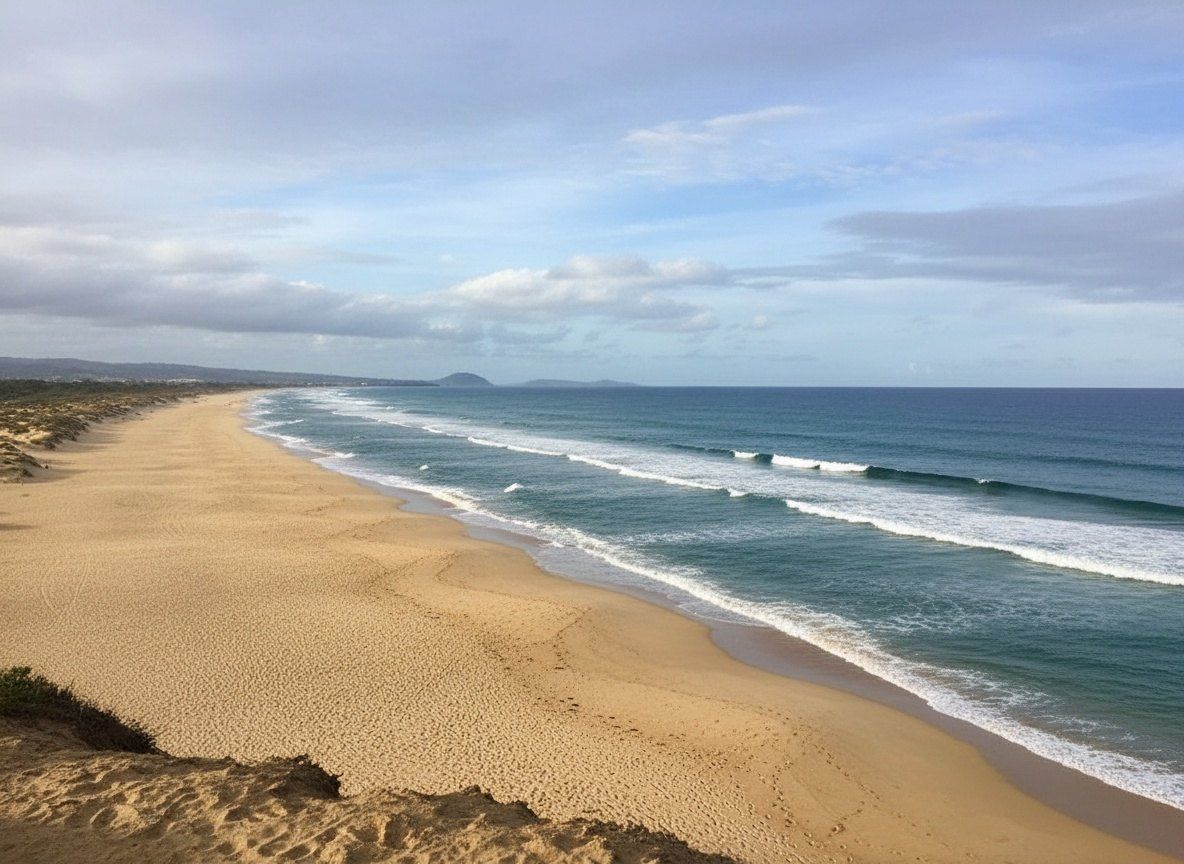 Porto Santo features a 9 km long beach along its south coast accessible by ferry from Funchal.
Choosing one
The mistake is to ask for a single best beach. The right one depends on who is swimming.
The best beach in Madeira for small children is a sheltered one with sand: Machico, 23 minutes from Funchal, or Calheta, 39 minutes, both with imported sand and a Blue Flag in 2026. For natural sand and scenery, Seixal on the north coast or Prainha in the east. For a swim with lifeguards and no sand at all, the Porto Moniz pools, €3 from the age of 3.
Staying in Funchal and short of time, stay in the city: Praia Formosa is free and 2 km long, the Lido complex is €6, and the São Tiago sea pool in the old town is free.
And for a week of sand, Porto Santo.
Madeira: Best of the East Tour from Funchal
★ 4.7 · 3,752 reviewsThe east coast in a day from Funchal, with Machico's bay on the way.
Prainha
People driving to the Ponta de São Lourenço often pass Prainha without stopping. It lies close to the eastern tip.
The Prainha beach Madeira is known for lies in Caniçal, in the municipality of Machico, near the Ponta de São Lourenço. Its sand is natural, coppery and of volcanic origin, unlike most of the island's beaches, and its surroundings are yellow and brown rather than green: the east is the dry end of the island.
It has a restaurant, changing rooms and toilets, parasols and sunbeds, and parking, and it carries a Blue Flag in 2026. Nearby, the Dunas da Piedade are dunes with limestone fossils of great interest to geologists.
Combine it with PR8 at Baía d'Abra, 34 minutes from Funchal, or with the Ponta do Rosto viewpoint, also in Caniçal. Visit Madeira has the details of each sand beach.
Common questions
Does Madeira have sandy beaches?
A few. Seixal and Prainha have natural sand, Machico and Calheta imported sand, and Porto Santo, the neighbouring island, 9 km of golden sand.
Where is the black sand beach in Madeira?
At Seixal on the north coast, about 47 minutes from Funchal by road, and at the Praia da Alagoa in Porto da Cruz.
How many Blue Flag beaches does Madeira have?
17 in the region in 2026: 14 on the main island and 3 on Porto Santo.
What is the best beach in Madeira for children?
Machico or Calheta, both sheltered, with imported sand and a Blue Flag in 2026.